
I Opened the News at 5AM and Lost 30 Minutes Immediately
Morning!
It’s 5:00am on a Sunday.
Still dark. My boyfriend’s asleep. We share a studio, so I’m trying not to turn on lights or make noise.
I reach for my DreamNudge book… can’t see it. And it’s too dark to read without the lights on.
I have work later, so I tell myself:
“I’ll just rest for a minute and look at the news.”
That decision was incorrect.
30 Minutes Later
I’m fully awake.
Heart rate is up.
I know a lot of things I didn’t need to know at 5:12am.
And I’ve somehow spent the first half hour of my morning scrolling.
That part always gets me.
Not that I did it, but how fast it happens.
The Reset Moment
At some point I snapped out of it and had the usual thought:
“Okay… what just happened.”
And then:
“How do I not do that again tomorrow.”
What I Noticed
1. It didn’t feel good.
Which feels obvious, but it matters.
If something consistently leaves me feeling worse, it’s at least worth noticing.
2. I didn’t have a direction.
This was the real thing.
I woke up with no starting point. No “this is what I’m doing with this time.”
So my brain just… grabbed something.
And the easiest thing to grab is always your phone.
There’s actually research showing that when you don’t decide ahead of time what you’re doing, you default to whatever is most immediately available (Gollwitzer, 1999).
The Scroll Loop
And once you’re in it, it’s hard to get out.
Not because you’re doing anything wrong—but because the whole setup is designed to keep you there.
Endless content, constant novelty, no stopping point. It’s very easy to stay longer than you meant to (Alter, 2017; Eyal, 2014).
The Shift
Once I realized what was happening, I realized I needed to give myself a starting point.
I opened the digital version of DreamNudge instead:
And I picked one thing to focus on.
Not a full schedule.
Not a perfect routine.
Just:
“This is what I’m doing first.”
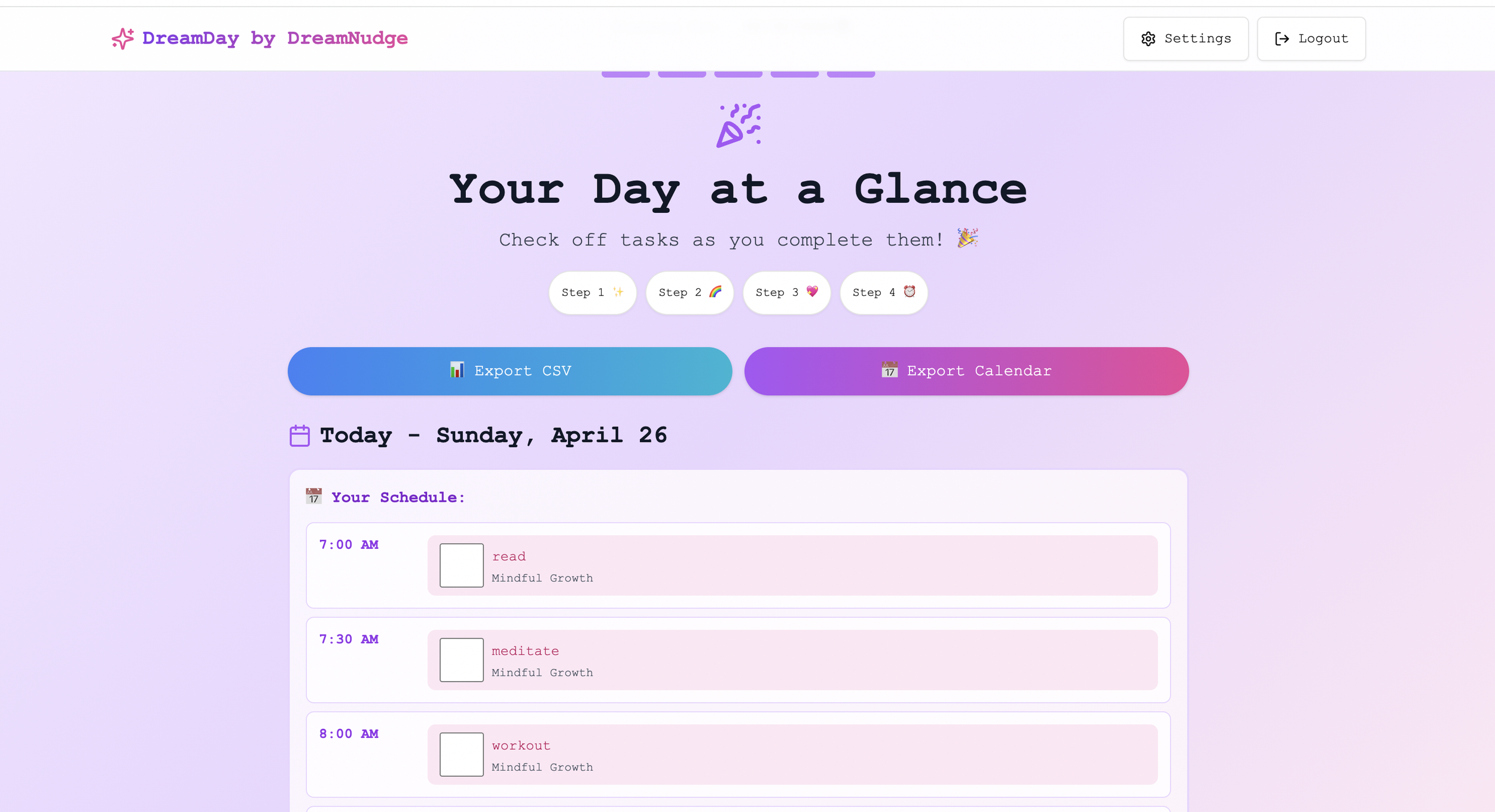
a screenshot of the dreamnudge app 3 phase planning strategy, DreamDay by DreamNudge: dreamday.tech
What Changed
It wasn’t dramatic.
But I stopped drifting.
That’s the main difference.
Without direction:
I scroll
I react
I lose time
With even a little direction:
I start
I move
I stay with something
Having even a simple plan like that makes it much more likely you’ll actually follow through, instead of defaulting in the moment (Oettingen, 2014).
The Balance
I don’t want a rigid plan for every hour of the day.
But I also don’t want to lose the first part of my morning to something I didn’t even choose on purpose.
So the middle ground is:
a little bit of direction, and then letting the day unfold from there.
Final Thought
The issue wasn’t that I looked at my phone.
It’s that I hadn’t decided what I was doing instead.
Once I did, it was easy to move on.
If You Want This Without Overthinking It
If you want a little more direction in your day (without making it a whole thing),
you can start here: https://www.dreamnudge.com
Or join the Patreon!: https://www.patreon.com/c/dreamnudge/membership
Works Cited
Gollwitzer, Peter M. “Implementation Intentions: Strong Effects of Simple Plans.” American Psychologist, 1999.
Oettingen, Gabriele. Rethinking Positive Thinking, 2014.
Alter, Adam. Irresistible, 2017.
Eyal, Nir. Hooked, 2014.
Schultz, Wolfram. “Dopamine Reward Prediction Error.” Neuron, 2016.
